Corporate Blog of Elite - Professional Translation Services serving ASEAN & East Asia
In a world of profit driven organizations, Corporate Social Responsibility (CSR) is a difficult dream to achieve. CSR generally means integrating social values and mission statements of organizations within business decision-making in order to achieve positive and sustainable outcomes towards business, environment and the community at large. Easier said than done as we all know that money makes the world go round, especially during these trying global recession periods. So it is remarkable whenever certain organizations go the extra mile and make the extra effort to make this dream a reality.
Elitebilingual Pte Ltd's Managing Director, Ms Hong Yinyin has such a compassionate heart that is evident in some of the little known acts of charity which were carried out. Of most notable mention of all the translations that were carried out were for the organizations as follows; the Singapore Children's Society, United Nations World Food Programme, Ministry of Community Development, Youth and Sports (MCYS) and Fei Yue Community Services (FCYS).
The Singapore Children's Society is a non-profit organisation that helps protect and nurture children as well as youths of all races and religion, especially those who were abused, neglected and/or from dysfunctional families. So when Elite was approached by them to translate an article about *Maria (*Maria is a pseudonym used to protect the identity of the child) we felt dearly for the children and that we should give back to society and decided to do this project for free.
An example of the translation is as follows below.
This is Maria.
这是玛丽亚的故事
She is struggling with her studies, while nursing her paralysed mother.
Her elder sister, aged 17, works part-time to provide for the family.
Her father has abandoned the family.
You can help Maria…
她除了要应付繁重的功课,还得照顾瘫痪的母亲。
她的姐姐今年17岁,需要在外兼职才能养家糊口。
她的父亲抛弃了家庭,从此不见踪影。
玛丽亚需要您的帮助 …
Thus began a series of more translations that we felt that were for a viable cause and would be able to contribute to society.
The Miele Guide Restaurant Month was a charity initiative, carried out by Ate Media, that would specifically benefit the United Nations World Food Programme. Elite carried out the Japanese, Korean and Chinese translations continuously for a whole month pro bono. A link with both our organisations' websites was also placed free of charge to provide additional awareness on the programme. As the United Nations World Food Programme focuses on fighting hunger, reaching over 102 million people worldwide alone in 2008 with beneficiaries in 78 countries, we felt that it's definitely more than just; a cause worth fighting for.
Next is the Ministry of Community Development, Youth and Sports Singapore (MCYS). Their mission is to build a cohesive and resilient society by fostering socially responsible individuals, inspired and committed youths, strong and stable families, a caring, active community and a sporting people. We carried out a 4,000 word English to Mandarin translation service for them, focusing on stopping family violence, again free of charge. As Elite firmly believes in a balanced lifestyle and strong family values, these goals are aligned with our business goals and vision. Sometimes, it not just about profit, but about living as socially responsible individuals.
Last but not least, the latest project was for Fei Yue Community Services Singapore (FCYS), whose agenda was in effecting life transformation in people to lead them to a truly fulfilling life within an integrated community network. Over 16,000 words were edited by Elite for this project on "52 Steps to a Happy Marriage".
‘….To have and to hold, from this day forward, for better, for worse, for richer, for poorer, in sickness or in health, to love and to cherish 'till death do us part. And hereto I pledge you my faithfulness.’
Hopefully all these translations would be put to good use for the public and ultimately contribute to society in one way or another. The effects may be minimal and may not be immediately felt. However, the seeds of these had been sown and the way paved for future corporate social responsible actions to be tied in with organizational goals for Elite.
By Vincent Guee
Operations Manager, Elite
"We cannot tell what may happen to us in life. But we can decide what happens within us— how we can take it, what we do with it— and that is what really counts in the end. ~Joseph Fort Newton"
Showing posts with label translators education. Show all posts
Showing posts with label translators education. Show all posts
Wednesday, December 9, 2009


Monday, November 16, 2009
译者—戴着镣铐的舞者
Corporate Blog of Elite - Professional Translation Services serving ASEAN & East Asia
翻译真的是一门独特的艺术,是的,这里我把翻译称为一种艺术。艺术就需要创作,但是翻译这种创作又不是不受限制、信马由缰。所谓的镣铐就是原文,如果挣脱了这幅枷锁去自由发挥,那就不能称其为翻译了。所以,把翻译比喻成戴着镣铐跳舞是再合适不过了。这种情况下,翻译者自然就是戴着镣铐的舞者。戴着镣铐就是指在翻译过程中要受到原文的种种束缚。
还是把翻译比为舞蹈。舞蹈是通过音乐、形体、运动、表情及姿态来表达感情的一门艺术。优秀的舞者,一定具备两个层面的素质:一是舞蹈功底。没有技巧,内心再丰富的情感也会因缺少表达途径而无人理解。因此,这个难度和技巧就要靠平时的勤学苦练和点滴积累。技巧是展现的手段和工具。第二个层次,就是两个字:“精神”。有了过硬的基本功和高难度的技巧。该如何把这些和舞蹈的内在精神结合在一起。音乐响起时,肢体语言要感动的不只是自己,还有观众。感染力不是技巧的堆砌,是发自内心的对生活对生命的感悟,就像有人说过,高手是跳情而不是跳舞。
那翻译究竟是什么?美国著名的翻译理论家 Eugene A.Nida 给翻译下的定义是:Translating consists in reproducing in the receptor language the closest natural equivalent of the source language message, first in terms of meaning, and second in terms of style. 首先是 meaning (意思),第二就是 style(风格)。这两个方面正是我要用来类比舞蹈的两个层次:翻译既是语言活动,又是思维活动。语言活动是指使用完全不同于原文形式的译文来传达原文信息,所以“准确无误”是最基本的要求,这要求翻译者有深厚的语言功底,对源语言和目标语言都有正确的理解和纯熟的运用能力。同时,翻译也是再创作,原文和译文的等值,也只能是相对的等值,是信息等值或语境等值,而不是字词等值。中国贯通中西的著名文学家钱钟书说过一句话,“译者驱使本国文字,其功夫或非作者驱使原文所能及.故译笔正无妨出原著头地”。这句话可以理解成:翻译是两种文字的一种竞赛。从创作的角度去理解,译者和原作者都属于作者,两个作者表达的是相同的或者是相近的思想,同处在创作这个层面上,译者除了“求真(准确翻译)”还要“求美(用符合目标语言的审美观及价值观表现出译者和译文的风格及特点”。因此,从某种意义上说,翻译就是解释,是带有主观色彩的剖析和理解。翻译中求真和求美的矛盾随着创作和翻译之间界限的消失也得到了调和。
诚然,对于翻译究竟是一门科学还是一门艺术,长期以来诸子百家各执一词。也许是因为我无法改变自己内心对浪漫主义的向往,所以仍坚守:翻译就是艺术。就像英文有artist和artisian一样,华文里也有艺术家和工匠这两个貌似相近,实则内涵迥异的词。即使戴着镣铐跳舞,译者也应该跳得精彩、跳得漂亮!希望我可以做一个富于创作的艺术家,而不仅仅是一个工匠。不妨用文学翻译大家郭沫若的一句话做为本文的结语吧,“翻译家不是鹦鹉,应该在翻译过程中涌起创作的冲动”。
By
Jean Zhang | 张小锦
Chinese Translator / Editor | 中文翻译与编辑
Elite Bilingual Services Pte. Ltd.
Chinese Translator / Editor | 中文翻译与编辑
Friday, June 26, 2009
企业标语的诞生

方莺吟
董事
译力双语服务私人有限公司
 记得2000年开始在新加坡当翻译员的时候,我的老板兼师父说了一则香港国泰航空企业标语的故事。当时,国泰的英文标语是‘Arrive in Better Shape’。顾名思义,当你乘坐国泰航空,下机时准不会让灰头土脸。可是这样一句很‘英文’的标语,如何以几个中文字将整个形象表达出来,而又不失文采呢?
这当然不是件容易的事,不然国泰航空也不会重金征集佳句了。后来一位老先生以一句‘航行万里,神采飞扬’捧走丰厚奖金。相信他在领取奖金的时候,肯定也神采飞扬,笑不拢嘴。
成功的企业标语不但深入人心,而且寥寥数字所展现的神韵,确实能为企业形象起着画龙点睛的加分效用。
跨国公司,尤其是以消费群众为诉求对象的企业,不但在选用企业标语时要慎重其事,费尽心思(甚至是大洒金子),而且还要找一个能跟英文版匹配的中文标语,才能旗鼓相当,互映生辉。比如汇丰银行的‘The World’s Local Bank’,中文版为‘环球金融,地方智慧’,堪称是这几年较为知名的精彩译文标语经典。
有些人会说,哇,才想几个字就能赚这么多钱,很好赚哦!其实好标语都得惜字如金,既要简单明了,又要耐看耐读,而且要做到‘说得更少,寓意更深’,如同大师挥毫一样,寥寥数笔就能把一个人物的形和神跃然纸上,真的很考功夫呀!如果一个不小心翻得不好,对企业来说可谓得不偿失。企业的品牌价值,何止千金。想一想,如果我们把花旗银行的‘Citi Never Sleep’翻成‘花旗不睡觉’,肯定会让人笑到喷饭。当然,这种事也不太可能发生(正确答案是:花旗从不歇息)。
以前当个看热闹的门外汉,读到一些经典的企业标语,总觉得:嘿,这么简单,我也可以翻得出来嘛。所以在3年前创立译力双语服务公司的时候,就拿自己的公司来开刀,想了一个自认为不错的标语:‘译出飞扬神采,展现企业魅力’,刚好把‘译力’两字镶在头尾,将创立语言服务的使命放在中间。
自从听闻那一则国泰航空的标语故事后,整整过了7年,才终于让我有机会为一家本地银行的企业标语抄刀。这家在新加坡拥有超过百年历史的银行,要展现一种‘始终在您身边’的亲切老邻居形象。当时他们的英文标语是‘Your Bank and More’。但是自己的功夫还是不到家,墨水也不够,所以绞尽脑汁也没法交出佳句。后来,还是客户自己想出一个相当不错的标语‘伴您成长,与您相随’。
看到最后出炉的标语时,坦白说,我真的心服口服。虽然中英两句并排放在一起,只有‘您’字对得上号,而More字则大有文章。它包含着‘陪伴’和‘相随’,既亲切又诚恳,完全是一种柔性而没有傲气的诉求。搭配这个标语的,是一个身穿金色制服且笑容可掬的年轻女职员,完全契合该银行的‘邻里银行’定位。
丢失了第一个机会,第二个机会来得比我想象中还快。半年之后,这家银行又换了第二个标语:Neighbour First, Banker Second。直译起来,就变成‘邻里第一,银行第二。’当然,这种口号式而老套的标语,根本不会被看上眼。有了前车之鉴,我基本上也大致摸清客户的诉求和风格。
在当时呈上的文案中,有一些是自己不甚满意,但也只能拿来凑数的几个标语。
邻里优先,银行为次。----- 意思最接近,但没有很强的Feel。
心系邻里,服务优先。----- 缺少感动人的元素。
邻里优先,贴近您心。----- 这些词都有点老了。
一个月后,偶然间到该银行办事,随手拿起最新的宣传册,打开一看,当初的其中一个标语就静静地列在左下角 – 深耕邻里,伴您同行。那一种成就感,我到现在还记得。
Corporate Blog of Elite - Professional Translation Services serving ASEAN & East Asia
Tuesday, June 16, 2009
Translation Prices: Cost of Translation and Localization Services
by: Argos Multilingual
No, it doesn’t start with an "S” or an "F” and there is no "Q” in it. This word in our industry is ‘cena’ and it is the Polish word for"price”. Translation prices is exactly what we’ll be examining here. Price is usually, as anyone and everyone knows, the defining factor for customers on whether to purchase, and the defining factor for producers on how to target their products to the client base.
What horrible secrets about Eastern European translation pricing will be revealed in this article? Probably nothing too revolutionary. Hopefully this article will expose some common sense responses to issues with pricing, and probably address several universal problems shared by all translation companies and localization service providers in the rest of the world.
1. ROI – ‘Don’t bother localizing if you can’t make a profit’
There is plenty of talk about localization ROI and how it affects pricing. The decision of whether it pays to localize something before you decide to enter a market sounds obvious. Why then do we see companies complaining about localization costs in the context of their ROI?
The underlying issue here is that companies are complaining about their products’ lack of competitiveness. It happens, there’s no shame in that. No matter how you slice it, it comes down to money. And if there is not enough demand backed by money for a product, then localization, in the eyes of management, doesn’t seem to pay off. If an application is designed for Eastern European end users, then it either has to be relatively inexpensive or should be tailored to a specific niche market where lower sales volumes give an acceptable return. The Eastern European software market will not usually generate huge sales based on its size alone anyway.
As such, localization decisions are often put on a back burner, and investment decisions are based on poor information about the market. The result - a company finds itself in Eastern Europe before it has properly estimated sales potential. Then, normal business processes come into play; managers are pressed to make a profit, and we see the localization problem handed over to the local distributor.
All of a sudden, a company that specializes in software distribution is responsible for the software publisher’s image and quality in the local market. Local distributors are often very small, with little infrastructure, inadequate resources and small translation budgets (coming out of their own small pockets). Nonetheless, localization responsibility for the product is suddenly literally dumped upon them. This imposes additional problems on the distributors not only associated with added incurred translation costs, but also the problem with answering questions such as: ‘how to localize’, ‘what agency to hire’, ‘how to go about adapting the product to this region’…
It all boils down to one simple fact, distributors usually lack the experience in localization, and that lack of experience will further result in declining sales numbers and added costs.
Software publishers fool themselves into thinking that it is so much in the distributor’s interest to do a great job localizing the product (ergo, the distributor will have an easier time selling the product) that they, themselves, don’t need to worry about it. However, distributors usually don’t understand the complex issues connected with localization. Even if a distributor does recognize what’s involved, the "simple, low-value added service” attitude toward localization services prevails. The real world consequences are poor-quality localization and serious harm to the software publisher’s image and brand.
2. What’s going on among the bigger buyers of translation/localization services?
What are the organizational structures of larger buyers of localization services, and how do they affect the price of translation? It seems as if Microsoft is getting its act together by limiting the number of vendors and giving the remaining more work. IBM and Oracle also seem to be well-organized in this respect. Unfortunately, there are other large buyers of translation and localization services that have not addressed the issue of centralizing or streamlining costs.
It is quite remarkable how some large buyers deal with this problem. Our translation company, Argos Translations, works with one particular client directly through two different offices and indirectly through three other localization companies. Of course, we are paid different rates, negotiated completely independently with each of these channels. And now the punch line: the rates we receive working through one localization company are 50% higher than what we receive working directly for the client. So where are the client savings? Where is the streamlining? What about consistent terminology? The value of working through a limited number of MLVs is understandable, but what is the point of doing it a little this way and a little that way?
How the biggest clients deal with their translation and localization is only one issue. Another question is how far these companies are willing to go to lower localization costs. Last year, our company was in negotiations with a very large global company to take over a large portion of their Slovak localization work. I am not going to name any names here, but suffice it to say that this is one of the elite, with over $50 billion in annual global sales. Since this was a large, long-term client, and there were significant volumes involved (mostly documentation), we decided to quote this client the extraordinary attractive localization / translation price (at that time) of Euro 0.12 per source word.
The company got back in touch with us to tell us that they really liked our experience and wanted to choose us, but they had an issue: price. We asked whether it was a question of 1 or 2 Euro cents, and they made it clear that the price would have to be "significantly” lower. It was obvious that we weren’t even close to their price expectations. They were looking for Euro 0.07-0.08! How is it possible that the rates being paid by this particular global giant were so low? How does this reflect upon our industry? The only answer I can offer is that such clients receive low translation prices at the expense of similarly low level of quality that they obtain.
3. Quality: does anybody really care?
I was recently dozing through a translation conference as one of the speakers, a professor of linguistics, was discussing the ethical importance of a high-quality translation. I was suddenly jolted awake by a statement he made along the lines of "it is the translation vendor’s ethical responsibility to ensure the highest-quality translation.” When question time arrived, I duly asked what we should do if our client does not give us enough time to do the job in an "ethically responsible” manner. The gentleman told me that it was our moral responsibility to ask for more time.
As good and applicable as his reasoning is, unfortunately it almost never applies in the real world. I tried to imagine the response that I’d receive if I were to call my client and suggest, "Listen, I know this is a 1.2 million-word project, but you really should have met your development schedule. And I know that your priority was to ship FIGS first, but this was delayed. And now, on top of all that, you want us to use this outdated TM software because this is what your previous version was in, yet the TM database we have received is full of inconsistencies that need to be removed before we start translating the new version. What it really comes down to is that we are only going to have time to do the translation and have it reviewed independently TWICE. This won’t be enough to maintain our ethical language standards.”
Unfortunately, the truth is (maybe I shouldn’t be saying this too loudly) that our business is full of concessions. It is a humorous concept, really, when you take into consideration that we are supposed to offer incredibly high-quality, incredibly fast turnaround times at incredibly low rates. Obviously, something has to give here, and I believe that the way localization services providers handle this contradiction is by diminishing the definition of excellence in our industry.
The best companies in our industry are the ones that have the best systems in place to provide the highest quality possible while trying to maintain costs at a level that does not hinder such quality, according to "real world” business conditions. Otherwise, we’re all familiar with the concept of ‘garbage in, garbage out’. It is that simple, really.
Corporate Blog of Elite - Professional Translation Services serving ASEAN & East Asia
Monday, June 15, 2009
To Be a Good Translator
By Leila Razmjou
BA in English Translation
MA in Applied Linguistics (TEFL )
Iran
leilarazmjou@yahoo.com
Source: Translation Directory
Paper presented at the Second International Conference on "Critical Discourse Analysis: the Message of the Medium" in Yemen, Hodeidah University, October, 2003
In addition to being a member of our country, we are members of the world community, and this gives us a global identity. Therefore, it is quite natural for us to think about world affairs and cooperate in solving the world's problems. To do so, the first and most important tool is "language," which is socially determined. Our beliefs and ideologies are always reflected in our way of talking, although the connections are hidden and only "critical language study" reveals these hidden connections in discourse.
Furthermore, we know that a nation's culture flourishes by interacting with other cultures. Cultural variety opens our eyes to human rights, but cultural variety can only be recognized through discussions, which leads us back to the major tool for discussion: "language."
The role of language in the developing world is materialized through "translating," and since critical language study is concerned with the processes of producing and interpreting texts and with the way these cognitive processes are socially shaped, it can be considered as an alternative approach to translation studies.
The world is becoming smaller and smaller as the systems of communication and information are developing and becoming more and more sophisticated. In the process of such a rapid exchange of information and for the purpose of improving cultural contacts, one thing is inevitable, and that is "translating." This is why there is a need for competent translators and interpreters.
As mentioned earlier, the whole world is undergoing complex changes in different areas such as technology and education. These changes necessarily have an important bearing on systems of higher education, including translator training programs.
According to Shahvali (1997), theoretical knowledge and practical skills alone are not adequate to prepare students to face the developments in the field. There is a need for ability to adapt; therefore, it is necessary to focus on students' self-updating and to develop their relevant mental, communicative, and planning skills.
Training translators is an important task which should be given a high priority. The service that translators render to enhance cultures and nurture languages has been significant throughout history. Translators are the agents for transferring messages from one language to another, while preserving the underlying cultural and discoursal ideas and values (Azabdaftary, 1996).
The translator's task is to create conditions under which the source language author and the target language reader can interact with one another (Lotfipour, 1997). The translator uses the core meaning present in the source text to create a new whole, namely, the target text (Farahzad, 1998).
Bearing these facts in mind, the question is: what skills are needed to promote translating ability? And how can one become a good translator?
The first step is extensive reading of different translations of different kinds of texts, since translating requires active knowledge, while analyzing and evaluating different translations requires passive knowledge. Therefore, receptive skills should be developed before the productive ones; i.e. by reinforcing their passive knowledge, students will eventually improve their active knowledge. Receptive skills improve the students' language intuition and make them ready for actual translating.
A good translator is someone who has a comprehensive knowledge of both source and target languages. Students should read different genres in both source and target languages including modern literature, contemporary prose, newspapers, magazines, advertisements, announcements, instructions, etc. Being familiar with all these genres is important, since they implicitly transfer culture-specific aspects of a language. Specialized readings are also suggested: reading recently published articles and journals on theoretical and practical aspects of translation. The articles will not only improve the students' reading skill in general, but also give them insights which will subconsciously be applied when actually translating.
"Writing" skills, i.e. the ability to write smoothly and correctly in both source and target languages, are also important. Writing is in fact the main job of a translator. Students should become familiar with different styles of writing and techniques and principles of editing and punctuation in both source and target languages. Editing and punctuation improve the quality and readability of the translation (Razmjou, 2002).
Moreover, translation trainees should have a good ear for both source and target languages; i.e. they should be alert to pick up various expressions, idioms, and specific vocabulary and their uses, and store them in their minds to be used later. This is in fact what we call improving one's "intuition." Intuition is not something to be developed in a vacuum; rather, it needs practice and a solid background. It needs both the support of theory and the experience of practice. Language intuition is a must for a competent translator.
One of the most important points to consider in the act of translating is understanding the value of the source text within the framework of the source-language discourse. To develop this understanding, the translator must be aware of the cultural differences and the various discoursal strategies in the source and target languages. Therefore, the hidden structure of the source text should be discovered through the use of various discoursal strategies by the translator.
A good translator should be familiar with the culture, customs, and social settings of the source and target language speakers. She should also be familiar with different registers, styles of speaking, and social stratification of both languages. This socio-cultural awareness, can improve the quality of the students' translations to a great extent. According to Hatim and Mason (1990), the social context in translating a text is probably a more important variable than its genre. The act of translating takes place in the socio-cultural context. Consequently, it is important to judge translating activity only within a social context.
After developing a good competence in both source and target languages, actual translating may begin. But there is a middle stage between the competence-developing stage and actual translating: becoming aware of various information-providing sources and learning how to use them. These sources include: different monolingual and bilingual dictionaries, encyclopedias, and the Internet.
Using dictionaries is a technical skill in itself. Not all students know how to use dictionaries appropriately. Words have different meanings in different contexts, and usually monolingual dictionaries are of utmost value in this regard. Students need a great deal of practice to find the intended meaning of words in a particular context, using monolingual dictionaries.
Translation trainees also need to be familiar with the syntax of indirect speech and various figures of speech in the source language such as hyperbole, irony, meiosis, and implicatures. Awareness of these figures of speech will reinforce students' creativity and change their passive knowledge into active skill.
While there is a strong emphasis on developing source and target language competencies, the ways in which students can develop them should not be neglected. Group work and cooperation with peers can always lead the translating process to better results. Students who practice translation with their peers will be able to solve problems more easily and will also more rapidly develop self-confidence and decision-making techniques (Razmjou, 2002). Although there is a possibility of making mistakes during group work, the experience of making, detecting, and correcting mistakes will make the students' minds open and alert.
Another important point is that successful translators usually choose one specific kind of texts for translating and continue to work only in that area; for example a translator might translate only literary works, scientific books, or journalistic texts. Even while translating literary works, some translators might choose only to translate poetry, short stories, or novels. Even more specific than that, some translators choose a particular author and translate only her or his works. The reason is that the more they translate the works of a particular author, the more they will become familiar with her or his mind, way of thinking, and style of writing. And the more familiar is the translator with the style of a writer, the better the translation will be.
Translation needs to be practiced in an academic environment in which trainees work on both practical tasks under the supervision of their teachers and theoretical aspects to enhance their knowledge. In an academic environment, recently published articles, journals and books on translation are available to the trainees, who thus become familiar with good translators and their work by reading them and then comparing them with the original texts. In this way, trainees will develop their power of observation, insight, and decision-making, which in turn will lead them to enhance their motivation and improve their translating skills.
Therefore, translation studies has now been recognized as an important discipline and has become an independent major, separate from foreign-language studies, in universities. This reflects the recognition of the fact that not everybody who knows a foreign language can be a translator, as it is commonly and mistakenly believed. Translation is the key to international understanding. So in this vast world of communication and information overload, we need competent translators who have both the theoretical knowledge and practical skills to do their jobs well. The importance of theoretical knowledge lies in the fact that it helps translators acquire an understanding of how linguistic choices in texts reflect other relationships between senders and receivers, such as power relationships, and how texts are sometimes used to maintain or create social inequalities (Fairclough, 1989).
Finally, it is important to know that it takes much more than a dictionary to be a good translator, and translators are not made overnight. To be a good translator requires a sizeable investment in both source and target languages. It is one of the most challenging tasks to switch safely and faithfully between two universes of discourse. Only a sophisticated and systematic treatment of translation education can lead to the development of successful translators. And the most arduous part of the journey starts when translation trainees leave their universities.
Works cited
Azabdaftari, B. 1997. Psychological Analysis of Translation Process. Motarjem Journal, Mashhad, Iran. 21 & 22: 7-12 (Translation).
Fariclough,N. 1989. Language and Power. London, Longman.
Farahzad, F. 1998. A Gestalt Approach to Manipulation in Translation. Perspectives: Studies in Translatology, 6 (2): 153-233.
Hatim, B. & I. Mason. 1990. Discourse and the Translator. London: Longman.
Lotfipour, S.K. 1985. Lexical Cohesion and Translation Equivalence. Meta, XLII, 1, 185-92.
Razmjou, L. 2002. Developing Guidelines for a New Curriculum for the English Translation BA Program in Iranian Universities. Online Translation Journal, V. 6, No.2 http://accurapid.com/journal/20edu1.htm
Shahvali, M. 1997. Adaptation Knowledge, the Passage of Success and Creativity (Translation).
This article was originally published at Translation Journal (http://accurapid.com/journal).
Corporate Blog of Elite - Professional Translation Services serving ASEAN & East Asia
Sunday, June 14, 2009
How many words per day?
© By Anita Karlson Henssler
A freelance translator (English, German and Danish into Norwegian).
Join PolarZone - her Free Newsletter for the Freelancer.
CH-4313 Moehlin, Switzerland
akarlson@polartext.com
www.polartext.com
One topic most freelance translators just starting up their business devote some thought and calculations to, is this: How many words am I supposed to translate per day?
Well, it is a tricky question - and it doesn't really have an answer! We all have different working approaches, different speciality fields, different software etc. This makes it very difficult to generalize. You will soon notice yourself; two texts of equal length will take you different long to translate.
The main factors involved in deciding how many words you can translate per hour or per day are:
Text format - When you are working from hardcopies it takes longer than when you are working on electronic texts. It will also go quicker if you are working in a program you are very familiar with as opposed to a program you have just bought and are unfamiliar with.
Available dictionaries - Looking up words you don't know will go quick if your dictionaries are good. If you have to search for words - be it on the Internet or at the library - you will loose a lot of time.
Use of CAT-tools - If you are using a CAT-tool, the translation process will go quicker, especially if you are working on a repetitive text.
Speciality topic - The more familiar you are with the topic, the quicker the translating will go.
Style of the source text - Another factor is the style the author of the source text has used. If you compare two texts within the same topic you might find that one text will consist of floating and poetic sentences whilst the other will have short and hard sentences.
Typing speed - How quick can you type? This is also one factor determining how many words per day you get through.
Motivation - When you are having a bad day and not feeling too good, it will also be very difficult to get your work done. The more motivated and focused you are, the quicker you can translate.
Then you also have to calculate the time it will take you to edit and proofread your work. The translating job does not consist of just translating - you also have to check and double check your work!
The average translator will tell you that he or she can translate 100 words per hour working on a complicated text where he or she is not familiar with the topic and needs to do a lot of research. On the other hand the same translator will tell you he or she can do 500 words per hour working on an easy text in his or her speciality field.
When working on a project requiring extra effort an average translator will do up to 4000 - 6000 words per day. But this workload cannot be maintained over longer periods of time. An average translator will do between 2000 and 3000 words per day, working at a comfortable speed and also having time to revise and proofread his or her work properly.
Consider the following two translations: Translation 1 is a PowerPoint presentation consisting of 1200 words and the text is an environmental report. Translation 2 is a software manual of 3000 words written in Word. If you asked several translators to perform these two translations and then asked how long each translation took them, you would not get the same answer from any of them.
I would use about six hours for the first job and about seven hours for the second job, that is including editing and proofreading, not counting breaks. Even if translation 2 has over double the amount of words, I do not need much more time on that than the first translation. I am not very familiar with the topic environment. I would have to spend relatively much time researching the terminology and looking up words. In addition, I am not very familiar with PowerPoint either. Even though this is a relatively easy program, I am bound to run into a problem or two. A software manual, on the other hand, is right up my street. This is a subject I don't need to do a lot of research on, as I am quite familiar with the terminology used. In addition Word would not cause me any problems.
So basically you have to set your own standards. To do this you can time yourself. See how much you can translate of different types of texts in one hour. This way you get an idea of how much you can expect to do in a day of a certain type of text. You learn as you go - and soon you will be able to predict very accurately how long it will take you to translate any given text.
Copyright © 2003 Anita Karlson Henssler
Corporate Blog of Elite - Professional Translation Services serving ASEAN & East Asia
Saturday, June 13, 2009
Major mistakes when responding to job offers
By Natasha Cloutier
Chez Natasha
www.cheznatasha.nl
Wondering why you never got an answer to your e-mail? Sometimes potential clients do not have the time or simply do not need your services. Other times, it could very well be that your message is the real reason. Have a look at the following mistakes to see if any of them sound familiar and find out how to avoid these mistakes in the future.
Always check your spelling
Mistakes are unacceptable when selling language services.
Solution: Use a spellchecker and proofread your message.
Reason: It looks unprofessional and does not instil confidence.
Actually… It makes selecting potential candidates much easier.
Answer the client’s questions
Potential clients should never have to search for answers.
Solution: Make sure you actually answer their questions.
Reason: It looks like you haven’t read their job offer.
Actually… Who wants to work with someone who can’t communicate?
Resist applying for a freelance job following an in-house job offer
A potential client knows what they need better than you do.
Solution: Read the posting carefully.
Reason: It looks like you don’t care what your client needs.
Actually… It can look desperate.
Avoid using ‘Dear Sirs’
Reason: Using ‘Dear Sirs’ means you are making assumptions that could offend.
Solution: Use ‘Dear Sir or Madam’.
Actually… Women throw these ones out and men find them impersonal.
When answering per e-mail:
Do not send your résumé as an attachment unless asked
Solution: Paste your résumé into the body of your e-mail.
Reason: People will regard your e-mail as a virus and throw it out.
Actually… It’s quite irritating.
Do not automatically hit the reply button of your e-mail programme
Solution: Put the right e-mail address in your reply before writing.
Reason: You may need to send it to a different person.
Actually… You come off inexperienced and sloppy.
Sending e-mail to several people with their addresses showing
Reason: People respond better to anything addressed to them personally.
Solution: Test your e-mail by sending a message to yourself.
Actually… It shows a lack of confidentiality.
Other things to avoid
Writing in capital letters.
Actually… It looks and feels like screaming.
Sending an e-mail message with nothing but “see attachment”.
Actually… It looks like spam, it’s impersonal, and will be thrown out.
Applying for a job offer that does not match your qualifications.
Actually… It can look desperate and it is a waste of time.
Using a tone that is either too humble or too overbearing.
Actually… It sets a bad tone for any future dealings.
Corporate Blog of Elite - Professional Translation Services serving ASEAN & East Asia
Friday, June 12, 2009
FIST - First International Strike of Translators
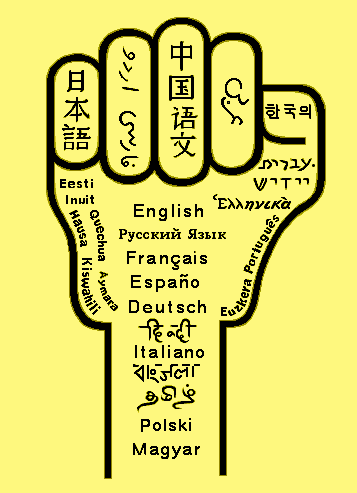
Only A Fantasy?
By Alex Gross
http://language.home.sprynet.com/
alexilen@sprynet.com
This article is at least partly a fantasy. I know all the reasons why the events I am about to describe are unlikely to take place in the near future. I will even examine these reasons in some detail towards the end. But for now let us simply entertain the idea embodied in my title and see where it leads us. Let us imagine that all the professional translators in the world, working in their separate countries in business, science, diplomacy, or even espionage and the military, have in fact come together as a single group and have launched a strike under a single banner, First International Strike of Translators or "FIST," bearing a device something like the one shown here. Let's just assume this has happened or is about to happen. I then have three questions. Who precisely are we, the ones about to go out on strike? Assuming we can answer this and have decided we have something in common, what is it that we would want, what would be our actual demands? A strike—or the threat of one—is of course the classic weapon to resolve grievances, but we must first define what these grievances are and how they might be resolved. And finally, what effects could such a strike possibly have, both for ourselves and for the world beyond us?
Let us begin by talking about who we are, even though we may suppose we know this well enough. First of all, we are people who through birth, study and/or accident have come to be familiar with two or more languages. In all but a few countries this already marks us as unusual. And even in those countries where bilingualism is more accepted, we still stand out because we habitually deal in the detailed process of crossing between our languages and in helping others to do so. In some countries this ability is held in awe, in others it is dismissed as a rote skill and/or a plentiful commodity, and in yet others it is the object of considerable suspicion. In none of these lands, even where translation is more commonplace, is the ability to translate regarded as altogether normal. After all, we translators can actually handle two or more languages, are able to live to some degree in two or more cultures, and may in fact have two or more loyalties. And in a world of single loyalties, single nationalities and single cultural choices, this marks us as different and also as potentially dangerous. We all know this of course, and we do the best we can to prove our loyalty to the countries and companies which employ us.
But if we are looking for something to unite us in our undertaking, this is certainly a factor worth considering. Whatever our nations, origins or loyalties, it is likely to be something we have in common. We are able to look at two or more different cultural contexts and explain the first in terms of the second and often the second in terms of the first as well. In a world of single loyalties this is a useful skill but also an odd accomplishment, something that marks us both as dull, devoted drones and as potentially divided outsiders.
Such an accomplishment is all the more remarkable in a world where at least some ideological and national distinctions are slowly beginning to blur, blend, perhaps relax a bit. Let's just suppose that some of the internationalist rhetoric we are beginning to hear is actually true, let's imagine that we really are moving into a broader, more multi-cultural world environment. What do we then become? Do we not first and foremost among all human beings bear the banner of such a change? Could it just possibly turn out that we are pioneers and heroes? If the world's definition of freedom were expanded to embrace being free to know more than one culture, might we not rank rather highly in such a hierarchy of freedom? Is all this also a fantasy, or is it something worth considering? Such is my partial answer to the question "Who are we?"
And now the second question: what is it that we want? Assuming we could get every translator in the world to go out on strike with us, what would we ask as conditions for returning to work? Would we merely insist on the time-honored demand of improvements in pay and working conditions? Would we perhaps add a few clerical caveats on the maximum numbers of words to be translated per hour? Would we express Luddite dismay at the appearance of computers in our midst? Or would we launch some truly powerful salvos on the philosophical and educational level at a world that still fails to understand the true interactive relationship between language and reality? I am appending a tentative list of such demands—as I see them right now—and invite dialogue with readers to expand and refine them.
PROVISIONAL DEMANDS OF THE FIRST INTERNATIONAL
STRIKE OF TRANSLATORS
1. Specific demands concerning pay, working hours, and work conditions, to be formulated cooperatively by an international committee, with possible differences according to specific conditions in various countries and societies.
2. Explicit recognition by all the world's governments of the primacy of the translation process in international communication and a commitment from these governments to ensure, in cooperation with our standing committees, the highest possible standards of translation in all such communication media.
3. A further commitment from the world's governments and universities that they regard language/translation as the major fountainhead of culture and human understanding, and that they realize that knowledge and science are more likely to be seen in the future as a branch of language than language as a branch of knowledge or science.
4. The granting by all countries (or by an international organization) of special passports for translators, similar to those issued to diplomats, facilitating travel for them in all foreign countries they may wish to visit.
5. Granting translators the option to refuse to translate texts they find morally unacceptable, for example declarations of war, terrorist demands, death threats, statements that one nation or people is intrinsically superior to another, assertions about religious or political systems that are injurious to those holding different views. In such cases, translators would at least have the option of returning these statements to their authors for further thought and redrafting. While this demand may appear radical at first, it in fact reflects a process already at work in some international organizations, where the fine print and fine tuning of international agreements sometimes reaches its final shaping in the hands of translators or results from a cooperative process involving them.
6. Gaining widespread recognition and publicity through national and international bodies for what is at present a barely perceived reality, namely that the quality of a translation is to a great extent dependent on the quality and clarity of the original text. Just as it is rarely possible to make a clear xerox from a fuzzy original unless it is first enhanced, so a poorly conceived and indifferently written original text can be just barely rendered into a foreign language with considerable help from the translator. In practical terms, Adjudicative Committees comprised of translators should be formed to deal with problems arising in this area. In major cases where complaints of an "unfaithful translation" may be lodged, the role of such a committee would be to determine if such complaints are justified or if any truly faithful translation would have been possible in the first place. Where complaints are found to be unjustified, the committee shall be empowered to fine those lodging them for willful abuse of the translator and to require them to bear the expense of such proceedings. Decisions of such a committee shall be binding.
7. The right of translators to function as final advisors on the feasibility and usefulness of all computer-based translation aids and to determine standards on how these will be used in their work. This by no means indicates hostility to such devices among translators, many of whom are actually curious or even excited to learn how such devices can help them in their work. This demand merely confirms two recognized circumstances, that the use of computers in translation is still a relatively new and untried process, and that there is a great deal of misleading information in this field. A computer system may work brilliantly in the hands of its inventors and yet create intractable problems when integrated into normal work routines. Some systems which work well in one setting are less successful in others. Other systems, touted only recently as useful translation aids, have disappeared along with their manufacturers. Furthermore, as with interpreters, whose work is often so demanding that they can only work for brief one- or two-hour shifts, there may also be special human needs connected with using computers in the demanding field of translation. This could prove especially true in those cases where advocates of complex and expensive systems promise vastly increased outputs without considering the work or health needs of human translators.(1)
And now our most crucial question: would we actually be able to realize these demands by launching—or threatening to launch—such a strike? This question strikes at the heart of our fantasy and also forces us to consider the reasons why, according to many, such a strike could never in fact occur. Or, if it did, could never succeed. I will consider these arguments in a candid manner and without totally denying that such criticisms have some merit. But it also is worth considering that what seems totally impossible today may not be at all impossible a few years or a few decades from now.
The first thing we should clearly realize is that we are under no obligation to begin such a strike right away. In fact all practical experience in this field dictates that we should not begin it until we are truly ready. The key to all successful strikes is capable, prolonged, and thorough organization, and this would clearly involve endless work. In the meantime the mere announcement that translators might be planning such a strike or are even discussing its possibility can, in a media-driven world, begin to give us some of the publicity we need to start mobilizing our own resources. It is just possible that we already possess some of the necessary power—we simply need to make this power manifest and begin to shape it in the public awareness and in our own. No doubt some early reports would ridicule our efforts and suggest that they are doomed to failure, as the world at large does not tend to view translators as very important in the scheme of things and supposes that we are all easily replaceable, whether by other translators or by machines.
But it is precisely here where our organization and research efforts should concentrate, in order to prepare a credible response to such charges. Thus, I visualize the initial effort to realize these demands as being one of prolonged discussion, organization, international coordination and "consciousness raising" among ourselves, along with a parallel publicity campaign to keep the press and general public apprised of our intentions and progress. One major goal of these discussions and organizing activities will be to provide others and ourselves with accurate answers to our last question: what would happen if the strike actually took place? And to prepare practical answers to this question beforehand.
At this point I am prepared to claim on the theoretical plane—leaving some of the hardest questions for last—that if we were successful during the discussion and organization phase, and if we really were able to persuade all translators and interpreters in all fields in all nations to go on strike with us, the results could be nothing less than astounding. Business, communications, international relations, science, the military, espionage, patent registry, and applications for international jobs and divorces would all come to a grinding halt. The entire world—ourselves not least of all—would be astonished by the truly enormous power that flows through our hands.
But how would the world react to such a strike, you must by now be asking, would not all governments everywhere simply rush out and hire others to take our places, leaving us all out on our ears without a job? The answer to this question would depend on how effective we had been during the earlier phase of publicizing our demands. If we did a good enough job here, we might never actually have to go on strike. It might be possible to convince the world's governments and businesses of our enhanced value without ever having to fire a shot.
Here we would need to stress the specialist nature of our work and persuade the public that it would be far harder to find replacements for us than they think. We do more than move words and phrases around, we regularly fashion and transfer entire realities between nations. But even if we failed in this effort—and even if we failed in our strike—we would still have the satisfaction of knowing, as we stood on the unemployment lines, that it was only a question of time before our replacements came to feel the same way about their work as we do and began to voice the same desires and grievances. We are after all a very special group of people, and any others who try to play our role must necessarily be or become much the same people as ourselves.
It's time to consider the really hard questions, which I have postponed until now. I am of course well aware that as of now not all translators will share my views or even grant the need for such a strike. I also know that many translators have worked so long as intermediaries and are so accustomed to professional self-abnegation that for them any such appeal to activism must seem profoundly inappropriate. Other translators work directly for the government or the military and are certain their employers would never countenance anything like what I have described . Yet other translators work in countries where the legitimacy of any strike by the citizenry, much less by government workers, has never been granted. Thus, as innocent and well-meaning as we may see ourselves and our cause, some of us could actually end up being jailed—perhaps even executed (this is after all a fantasy)—for our efforts. Yet I believe that solutions might become possible in all these cases, provided we are not in too great a hurry.
On the positive side, translators and interpreters are already international by the very nature of their work. We share an international network of contacts, professional groups, and publications. It is by no means impossible that we can spread the word of our plans far and wide. We are after all also a relatively small group of people, and this has advantages as well as disadvantages. Some may also argue that business and government would simply ransack the schools and universities for linguists to take our places. We can provide against this by expanding our group in the first place to embrace all language professionals, including teachers, perhaps restyling ourselves as FISTITALP or "First International Strike of Translators, Interpreters, Terminologists, and Allied Language Professionals." Or we can just let the government go ahead and draft language professors—it might be amusing to see if they are really able to translate.
At this point, my fantasy—to the extent that it is a fantasy— is running low. It really does seem to me that there ought to be some means by which translators can come to enjoy more recognition than they now receive. They are in a very real sense life's true aristocrats, connoisseurs, and Kenner, its enjoyers of multi-realities, as anyone knows who has ever heard them converse or joined them at table. In an increasingly sophisticated and multicultural world they—unlike wealthy idlers, businessmen or scientists—are the true distinguishers of the world's many realities and the touchstone of the differences between them. It is hard to believe, strike or no, that they will not soon be recognized for their unique pioneering qualities.
But of course some will simply smile my fantasy away. Such a scenario surely belongs only to the future. Or perhaps someone will come along, do everything I have described and more, and describe me as an old fuddy-duddy for even calling it a fantasy.
(1) For further information about these aspects, see Jean Datta's excellent treatment Machine Translation in Large Organizations: Revolution in the Workplace, pp. 167-173, Technology as Translation Strategy, American Translators Association Scholars Monograph Series, Vol. II, 1988, edited by Muriel Vasconcellos, University of New York at Binghampton (SUNY).
Corporate Blog of Elite - Professional Translation Services serving ASEAN & East Asia
Thursday, June 11, 2009
"Waiter! There’s an insect of the order Diptera in my soup!"
By Karen Elwis
21st October, 2004
Translation Company in London: Lingo24
The following genuine examples are an amusing reminder of what can happen when you don't use a professional translation company...
On menu of Swiss restaurant: "Our wines leave you nothing to hope for."
On the door of a Moscow hotel room - "If this is your first visit to the USSR, you are welcome to it!"
Useful advice on how to drive Tokyo style: "When passenger of foot heave in sight, tootle the horn. Trumpet him melodiously at first, but if he still obstacles your passage then tootle him with vigour."
Bucharest hotel lobby: "The lift is being fixed for the next day. During that time we regret that you will be unbearable."
In Austrian ski resort: "Not to perambulate the corridors in the hours of repose in the boots of ascension."
Shop entrance in Majorca: "English well talking. Here speeching American."
In a Paris hotel elevator: "Please leave your values at the front desk."
In a Bangkok dry cleaner's: "Drop your trousers here for best results."
On menu of Polish restaurant: "Salad a firm's own make: limpid red beet soup with cheesy dumplings in the form of a finger; roasted duck let loose; beef rashers beaten up in the country people's fashion." [Wonder if they ever caught the duck?!]
All goes to show - when it comes to translation, you need the professionals!
© Lingo24 Ltd
Translation services - Lingo24 is a leading provider of translation services between all major world languages. Based in the UK, the company also has full-time operations in China, Romania and New Zealand.
Corporate Blog of Elite - Professional Translation Services serving ASEAN & East Asia
Wednesday, June 10, 2009
The language of business – how fluent are you?
By Karen Elwis
14th November, 2004
Translation Company in London: Lingo24
In an increasingly global marketplace, it's high time that UK exporters realised the importance of translating or localising their sales websites into foreign languages. Karen Elwis has found a quick test to ascertain readers' current level of expertise in European "commercial-speak".
Foreign languages and business culture can be major headaches for British exporters, yet surprisingly few companies employ in-house linguists and many have no system in place to deal with commercial enquiries in a foreign language. Of course, many British export managers claim that most business is conducted in English anyway. However, in the current global market such a myopic approach to international trade could cost them more than they think. For today the power of the Internet can allow exporters to reach previously unattainable customers in far-flung parts of the globe, and businesses who have had the foresight to have their website translated into the languages spoken in their target marketplaces or ' better still ' "localized" (translated AND culturally adapted), are reaping the benefits big-time.
To see how you measure up when it comes to foreign languages, why not have a go at the following quick multi-lingual quiz, first published in an edition of Director magazine.
FRENCH
Donnez-moi vos coordonnés et je vous l'envoie tout de suite.
1. Tell me your address and I will send you a whole set.
2. Give me your details and I will get it to you at once.
3. Give me your tailor's address: I envy you your suit.
4. Let's co-ordinate this and I'll send you the whole suite.
Nous respectons toujours les délais de livraison.
1. We always respect delivery delays.
2. We carry out our deliveries by relay.
3. We always meet our delivery dates.
4. We have late deliveries every day.
GERMAN
Wir liefern frei Haus innerhalb Englands.
1. We deliver free houses in England.
2. We run free houses in England.
3. We ran free around England.
4. We do free delivery within England.
Bei dieser Menge kann ich Ihnen einen guten Rabatt anbieten.
1. I can offer a good discount on that quantity.
2. In a place like that you can always find your way.
3. Would you like some good rabbit in that mixture?
4. I can get you a good rebate.
SPANISH
Les presento un equipo muy competente.
1. Let me present you with a very competitive piece of equipment.
2. I'd like to give you a very competent piece of equipment.
3. I'd like to introduce a very fine piece of equipment.
4. Let me introduce you to a very competent team.
Vamos a aprobar el acta de la reunión anterior.
1. We approve of the actions of the previous board.
2. Let us approve the minutes of the last meeting.
3. We are going to test the actions of the last meeting.
4. Let's go and act out the previous reunion.
ANSWERS: French 2,3 German 4,1 Spanish 4,2
© Lingo24 Ltd
Translation services - Lingo24 is a leading provider of translation services between all major world languages. Based in the UK, the company also has full-time operations in China, Romania and New Zealand.
Corporate Blog of Elite - Professional Translation Services serving ASEAN & East Asia
Tuesday, June 9, 2009
Hints for Translators
By Korina Hansel,
an experienced Germany-based freelance translator & author
and member of the Babelport SiteTeam
Leipzig, GERMANY
www.babelport.com/members/23
The translation market profited enormously from the globalisation, which took place over the past decades. How can you profit from this development?
The business of translation has become highly competitive. Prices are constantly decreasing due to the vast availability of service providers worldwide, which does of course depend on the language combination you are offering.
Clients who need the services of a language professional often do not value the work that is done and regard spending money on translation as a necessary evil, not taking into consideration that the text that needs to be translated (be it a manual, a presentation or business correspondence) also serves as an advertisement for their business, a sector which has had rising profits over the past decades.
Why not take some of this budget and put it into high quality translation that reflects the professionalism of the enterprise concerned? This, in turn, would put the translator in a much better position since his/her work would at last be valuated appropriately. It is, however, in the hands of the translators to stop complaining and start taking action. First, translators need to develop more self-esteem and pride in their profession. Second, translators need to develop and stick to strict business ethics. Last, get in contact with each other and share your experiences with your fellow translators.
Anyone who knows two languages to a certain extent can "translate", meaning that he can put words from one language (the source language) into another one (the target language). Yet there is much more to translation than just that and many people " those offering as well as those requesting translations " unfortunately, do not recognise this. Words are more than just meaning: words convey emotions and cultural concepts, which may exist in one language but not in another.
Thus it is the job of a translator to create target texts, which are truthful copies of the original but read as if they were originals in the target language. Translation is a demanding process that not everybody who knows two or more languages can master. A good translator loves languages and is totally dedicated to his/her job.
This includes the desire to constantly improve one's linguistic knowledge and to deepen the knowledge of his specialized field(s). Since the majority of required translations are "technical" ones, meaning translations in fields, which have their own specialized terminology, as opposed to literary translation, each translator is required to specialize in one or more fields (such as legal, financial, medical, IT-related, texts).
This means that one will have to stay in touch with the developments in these areas, even if one does not have translation jobs in one or more of his specialized fields for a while. Therefore, read as many newspapers, magazines and other publications concerning your specialization as you can. Try to organize your working day, which is especially important if you work from home. Let your clients know when they can reach you, and be available at those times, but do not forget that nobody can work 24/7. Leisure time is just as important as strict office hours are.
You should always be prepared that potential clients will ask for your rates, which you will have to know by heart. If you read the manual How to calculate your per word rate you will get an idea about what your minimum rate would have to be. Add a certain amount to this basic price since of course you are working in order to make a certain profit on top of only covering your basic needs. Let your clients know that.
Networking is the key to successful self-employment. This means that you should not only send your résumé to those agencies/clients that might benefit from your experience but also get in contact with your colleagues. You will probably profit from their experiences and be able to help them out when they need your advice.
Thus you are able to market yourself and gather useful information at the same time. Moreover, try to get in contact with freelancers working in other fields, such as marketing, web design etc. Who knows when they might need a language expert to translate their texts or websites into another language? And if you feel that you are not suitable for one job or another you will probably know someone you can refer to your client. Remember that it is most important to satisfy your clients. If you feel that you might not be able to satisfactorily fulfil your client's demand at one point or another let him/her know so and, if possible, refer the services of a colleague.
When it comes to dealing with agencies and direct clients be sure you settle all terms of payment, i.e. rate per source or target word/line etc., when and how payment will be received and so on, before even accepting a job. Make sure you have all necessary contact information at hand. An email address is not sufficient; if it has not been provided ask your contact person for his/her full name, postal address and telephone number.
The correctness of this information can easily be checked via the Internet, by calling that person and any other means available. Although the Internet provides a convenient, fast and easy means to get in contact with business partners anywhere in the world, it also comes in handy for those black sheep in the business who take advantage of the seeming anonymity of this technology.
Translation resources like babelport.com aim to minimize the risk involved in doing business via the Internet by establishing platforms where your customers can be rated according to your professional experience with them. So please make sure that you rate any agency or direct client you have worked for in order to help your colleagues.
Republished with permission by author and babelport.com - The translation industry information and project portal Visit http://www.babelport.com
Corporate Blog of Elite - Professional Translation Services serving ASEAN & East Asia
Monday, June 8, 2009
The state of the language within the state of the industry
By Bernie Bierman,
the author of "A Translator-Warrior Speaks: A Personal History of the American Translators Association",
Pawling, NY and Marco Island, FL
supremo [at] bbtranslations . com
To commemorate and celebrate its 50th birthday this year, the American Translators Association (ATA) has commissioned a history of the organization, and by extension – if you will – a contemporary history of translation in the United States.
Now then, without having seen a single word of the draft of that history, and indeed not having been privy to any of the behind-the-scenes workings, I can say with all of the definitiveness that I can muster, that not a single word will be written about or a single reference made to the language, linguistic, communications and writing abilities of those who labored in the translation industry some 30 or 40 or 50 or even 75 years ago. And clearly, there will not be a single word written about or a single reference made to the language, linguistic, communications and writing abilities of the early or even middle-period leaders of the ATA and the American translation industry.
If the name Alexander Gode (the co-founder of the ATA) is mentioned, it will not be in conjunction with the man’s awesome knowledge of language and linguistics, his unparalleled eloquence, his remarkable ability to paint landscapes with words.
If the name Lewis Bertrand (one of the leading translator-merchants of his day, if not the leading one) is mentioned, there will be no references to his writing abilities or to his credo that translation is communication and translation is all about communication, language and writing.
If the name Henry Fischbach (the other co-founder of the ATA) is mentioned, not a single word will appear about this man’s writing skills and talent, about his painstaking and meticulous attention to every single word, every single sentence, every single phrase in a translated text that passed before his eyes.
Indeed, there will be no mention of the volumes of carefully-constructed, word-sensitive and eloquent letters, memoranda, reports, essays and other assorted writings of all of those translators who passed before us, all those who made the term “wordsmith” synonymous with translator.
To paraphrase the words of the American writer, Ben Hecht, “Look for these men and women only in the history books, for they are a civilization gone with the wind”. And clearly they are gone with the wind, or better yet, “They are translators of another time”, as was said by one Jost Zoetsche, one of the industry’s new breed of technological translators and the writer of a monthly column on the various technologies (sexy and otherwise) that today’s translator must master. Indeed, when Mr. Zoetsche said those words to me, there was not a hint, not a note, not an overtone of nostalgia. He said the words as if he was talking about … dinosaurs.
* * * * *
The American translation industry, not unlike other industries has seen and undergone some very discernible, if not radical changes in the past 50 years. It almost goes without saying that technological advances have wrought some of those discernible and radical changes.
But this piece is not about technology or the technological advances that have changed the American translation industry. Rather, it is about the changes that have come to its very core elements: language and communication. It is about the subordination – perhaps the word “belittlement” would be more appropriate – of those core elements to the exigencies of commerce and marketing and all that is commonly associated with those endeavors.
The piece of writing that is transcribed in full below is in my most considered opinion a highly representative piece of evidence that clearly demonstrates how language and communication have been shamelessly subordinated – even trivialized - in an industry whose raison d’être is language and communication.
100 years ago, 75 years ago, 50 years ago and even to a limited extent 25 years ago, when Mr. Zoetsche’s “dinosaurs” ruled the American translation countryside, the business side of translation (namely the translation bureaus or translation service companies) was in the hands of so-called “merchant-translators”, namely men and women who combined language skills with a modicum of business acumen. Most of these merchant-translators had academic backgrounds in language or the humanities or the natural sciences; a few combined language skills with backgrounds in diverse fields of engineering.
Not a single one of these merchant-translators, these “dinosaurs”, could claim an academic background in business. Yet, despite being bereft of a business model, a business plan or some other piece of commercial architecture of like purport and tenor, many of these merchant-translators went on to have highly successful business careers and were able to garner many of the attendant pecuniary benefits for themselves and their families.
And if during their careers these translator-merchants sharpened their business wits, never ever did they permit their language wits to become dulled. These merchant-translators, the dinosauric relatives and ancestors of today’s high priests and priestesses of business and technology, never lost sight of the core elements of their business: language and communication.
* * * * *
The early 1990’s saw the beginnings of change in the U.S. translation industry, at least so far as concerned the business side of translation. Naturally, at first these changes were barely discernible. The dinosaurs, i.e., the merchant-translators still appeared to be the dominant species in the commercial countryside. But these dinosaurs failed to lay eggs, and if they did lay eggs, those eggs were sterile.
Rather, the eggs were being laid and hatched at the graduate business schools of American universities. And that quaint, bucolic, somewhat backward translation industry, with its vast international potential, was viewed as virgin territory by America’s new darlings of commerce: the holder of the MBA.
It was obvious, particularly in short retrospect, that the new businessman or businesswoman of the translation industry didn’t care a whit about the industry’s core elements of language and communication. Those were aspects to be left to others…others whose tastes leaned towards the esoteric and ethereal. The tenets, the dogma, the doctrine learned in graduate business school would be applied to an industry whose dinosaurs were too dumb and/or shortsighted to exploit its vast richness. The translation industry would become the testing ground for the lessons learned in business school: business models, business plans, marketing, advertising with heavy doses of buzz words, trendy terms and technological gobbledygook.
And it worked. And it worked beautifully. The dinosaurs soon died off and became extinct, as they had in Walt Disney’s animated depiction of Stravinsky’s “Le Sacre du Printemps”.
* * * * *
“Now you never have to translate the same phrase again”, pitches one of the numerous purveyors of the latest technological darling (and/or god or goddess) of the translation industry: the CAT tool. And the technological gurus and gurettes of the industry never cease to remind us that never having to translate the same phrase again is not only the key to survival, but also the key to entering the great castle of prosperity. After all, as Noam Chomsky, the greatest of language technology gurus said way back in 1962, all language can be automated and mechanized.
Indeed, why bother to write when chips can write for you? And that doctrine has certainly not been lost on the 21st century’s translation merchant. In fact, it is not just doctrine, but equally dogma and catechism.
Let us now for the sake of the exercise look at a communication recently published in various translation media by TransPerfect Translations. I make one caveat and one caveat only: Do not focus on the content. The content is not at issue and it is not the issue. Rather focus solely on the language, the thought process (or absence thereof), the logic of the language (or the absence thereof). Look carefully at the grammar, the syntax, the communicative fiber. When you finish reading the communication, you might want to ask yourself the question, “What does this writing say of the product that the company – the industry - purports to offer?”.
In-house position French
Quality Manager - Canadian French
TransPerfect Translations was founded in 1992 with the following mission: to provide the highest quality language services to leading businesses worldwide. With no external financing, the TransPerfect family of companies grew from its humble beginnings as a two-person company operating in an NYU business school dorm room into the world's third largest translation and software localization firm and one of the fastest growing, privately-held companies in the United States. With a network of over 5,000 language specialists and over 800 full-time employees in over 52 locations throughout North America, Europe, Asia, and Australia, we're continuously ready to meet our clients' needs, around the clock and around the world. We attribute our growth to the skill, aptitude, and commitment of our high caliber employees. Put simply, we hire the most talented candidates and give them the guidance, resources, and opportunities they need to grow their career in an expanding environment.
Department: Production
Description:
Ensure translated documents mirror the original source document
Efficiently maintains formal disciplined operations procedures across a variety of client projects
Track project-specific non-conformances and resolutions
Personally perform project QA steps
Assist with making new department processes while improving on existing ones (improve productivity, profitability)
Build and maintain strong relationships with contract translators, editors, and proofreaders
Juggle overlapping projects and priorities in a fast-paced environment
Required Skills:
Minimum Bachelor's degree or its equivalent
Must have excellent communication (written and verbal) skills in Canadian French (native level) and English
Ability to support multiple projects by keeping accurate and up-to-date project specs
Excellent problem solving skills
Ensure customer sign-off of end product
Experience coordinating assignment of resources
Ability to maintain professionalism in all situations, especially under tight deadlines
Prior translation and proofreading experience preferred in Life Sciences, Marketing, and Finance.
Experience with Trados or SDLX preferred
TransPerfect is an equal opportunity employer.
TransPerfect offers a comprehensive benefits package for our Canadian employees.
If you think you have what it takes to succeed in a dynamic, fast-paced environment, apply at https://home.eease.com/recruit/?id=31740.
Your World. Your Future. Go Global!
For the benefit of those who are fairly new to our august industry and who share the belief that language and communication are not core elements of translation, but mere sundry, I will endeavor to address some of the more delectable morsels of the TransPerfect employment piece.
" We attribute our growth to the skill, aptitude, and commitment of our high caliber employees. Put simply, we hire the most talented candidates and give them the guidance, resources, and opportunities they need to grow their career in an expanding environment.."
I suppose that the issues of prepositional use and that little annoying thing called person, number and gender are in the paraphrased words of the late Captain Butler of Charleston, SC, "minor points, my dears".
Shortly after we are provided with the first example of the language skills and acumen [sic] of a translation services entity, we come upon a listing of the duties that will be performed by the manager in whose hands shall be placed the responsibility of upholding the great tradition of quality in writing, language and communication that has been the hallmark of what is clearly this correspondent’s most favorite translation agency since those halcyon days when its principal owner and grand gurette (Lizzie) was scurrying around the dormitories of NYU's august business school. And here are some of them there duties of the TransPerfect Quality Manager::
"Ensure translated documents mirror the original source document".
OK, good way to start off, even if a little, minor "that" is missing. After all, "that" is such an insignificant word. Really, it is just a botheration, an annoyance, a linguistic mosquito. Swat it away.
"Efficiently maintains formal disciplined operations procedures across a variety of client projects"
Ooooooo, a slight change in voice to the indicative, "Minor points, my dears, minor points". "Indicative", "Schmindicative". That's nothing but intellectual drivel. Has absolutely nothing to do with quality in writing, language and communication. Nothing.
"Track project-specific non-conformances and resolutions"
At this point I shall ask a real stoopid question: How does one track a resolution? I know how one could track incidences of non-conformance. But how does one track a resolution? Maybe we should ask dear Lizzie. After all, wasn't Tracking Resolutions 101 a prerequisite course at NYU Graduate Business School (along with attendant dormitory seminars)?
"Efficiently maintains formal disciplined operations procedures across a variety of client projects"
Ah, a return to the indicative. And of course the phrase “formal disciplined operations procedures” should be crystal-clear to everyone and anyone, except stoopid dinosaurs.
“Assist with making new department processes while improving on existing ones (improve productivity, profitability)”
I suppose “making” processes is sound English idiom. Of course, what would I, a stoopid dinosaur know. Using the word “formulating” would apply only to “translators of another time”.
And now we come to what is arguably the best part of this employment advertisement: the list of required skills. Here we have and see a living example of skills learned in graduate business school on how to organize one’s thoughts in a coherent, cohesive and communicative manner. Here are a few of my favorites as enunciated by TransPerfect, the provider of quality language services:
“Minimum Bachelor's degree or its equivalent “
Now I have heard of a Bachelor of Arts degree, a Bachelor of Sciences degree and a Bachelor in Business Administration degree, but I ain’t never heard of a Minimum Bachelor’s degree. Is that like a college equivalency diploma? Well, I guess that too is a “minor point”. But since I am fixated on minor points, maybe someone out there could clarify to me how a Bacehlor’s degree is a skill.
‘Ensure customer sign-off of end product”
Pray tell, is “ensuring customer sign-off of end product” a skill or is it one of the duties that would be performed by the person hired by TransPerfect? Ah, poor Lizzie must have fallen asleep in Thought Organizing 101.
“Ability to support multiple projects by keeping accurate and up-to-date project specs”
I have singled out this one solely because the word “specs”, which is really trendy, sexy and technologically alluring, is far better than that musty, dusty, old-maid-like, dinosauric word “records”. You see, it really doesn’t make a difference what word one uses – specs, records, papers, parchments, scrolls, etc., because in translation it really doesn’t make a difference. If the source language clearly stated, “…by keeping accurate and up-to-date project records”, and the translator wrote, “…by keeping accurate and up-to-date project specs”, who would know the difference? Who would really care? Truly, is there any difference between records and specifications? The most important thing is that you make it clear to the client that he, she or it is receiving a quality product or service and that he, she or it really and actually believes it.
* * * * *
I can tell you this: If in 1992, when Lizzie of TransPerfect was absorbing the fundamentals of marketing in graduate business school, I had read the above-transcribed piece aloud to an audience gathered at an ATA conference (née convention), there would have been roars of laughter and/or gasps of horror. After all, in 1992, translators and translation managers were still relatively cognizant of the core elements of their profession.
If I read the same piece today to an audience gathered at any translator function, I would probably be looking out at a sea of faces with the clear expression of “What are you talking about?”
And that is the way the cookie crumbles.
Published - April 2009
Corporate Blog of Elite - Professional Translation Services serving ASEAN & East Asia
Saturday, June 6, 2009
Getting The Client Localization Brief Right
By Claire Ingram,
Wordbank’s Assistant Director,
33 CHARLOTTE STREET, LONDON W1T 1RR, U.K.
TEL: +44 (0) 20 7903 8800, FAX: +44 (0) 20 7903 8888,
claire_ingram@wordbank.com
www.wordbank.com
How to avoid the GIGO syndrome, achieve deadlines and keep costs down.
The ‘garbage in/garbage out’ (GIGO) syndrome, where the quality of the output is in direct correlation to the quality of the input information, applies to many life scenarios but is particularly relevant to the localization process.
The successful management of localization projects to achieve most clients’ objectives – speed, value for money and effective communication in local markets - is dependent on three factors: well-written source text that can be adapted for local markets; an internationalized file format to enable the easy extraction and reinsertion of text to be translated; and efficient systems to manage the process throughout.
In most cases, the responsibility for the first factor lies largely with the global company or client; the second with its design agency; and the third with the localization specialist. If the first two fall into the GI category, then the chances for GO will be considerably increased regardless of the best efforts of the localization specialist to produce a silk purse out of a sow’s ear.
Not surprisingly, there is also a correlation between the quality of the brief from our clients and our ability to meet their speed and cost-effectiveness objectives. However, not all clients fully appreciate this connection. Whilst some are very good at sticking to the briefing template that we agree, all of our project teams can cite hair-raising examples of client briefs that have relied heavily on our extra-sensory and mindreading powers.
Recent examples include the ‘no brief at all’ which didn’t even specify the languages to be localized; a recycled brief which had a new project title but instructions and timelines relating to a previous project; and a file that just arrived out of the blue from a client’s agency without any clue as to the client ‘owner’. It took several emails and phone calls to track down the client to extract a brief and purchase order. In this article, I outline four main problem areas that we regularly encounter and our solutions for pre-empting or resolving them together with some of the golden rules that we use to help our clients save their time and money.
The Ideal Client Brief
Absolute Must Have Information
1. Source text – final approved version if possible
2. File format or proposed file format eg PowerPoint
3. Target languages by country eg French (Switzerland)
4. Mode of address preferences eg Polite or Informal
5. Language style eg Business Formal
6. Wordbank services required eg Marcom Translation
7. Delivery date eg All languages by ….
8. Delivery format eg PowerPoint
9. Client approval process
10. Purchase order or written confirmation to proceed
Helpful But Not Essential Information
1. Background to campaign or project and/or creative brief
2. Word count
3. Target market and audiences
4. Marketing communications objectives and desired response from target audience
5. Contact details for local approval contacts and their scope for making changes
6. Reference materials – existing collateral/web site that we can use as a point of reference to gauge tone of voice, imagery, style etc
7. Previous or similar recent projects
The best case scenario for any localization brief is that we receive it in good time, along with any sample files, to enable us to assess the suitability of the file for localization from a linguistic, technical and process perspective and to select the most appropriately experienced translators and editors to work on the text.
Our Copy Review and Technical Evaluation (CREATE) service not only ensures that the English text is well-written, clear, unambiguous and conforms with any specific corporate guidelines for terminology and style but also that it will be acceptable to the local markets from a cultural, idiomatic and visual perspective.
Clients and agencies who may have little experience of other cultures and religions are often unaware of the sensitivities attached to language and imagery and we frequently have to advise clients of their inappropriateness.
A common example is the use of visuals of dogs or women in Muslim countries. We recently had to advise a client who wanted to describe the resilience of their print cartridges by saying that they are subjected to ‘torture tests’ and they also used the phrase ‘torture supplies’. This basically means that the cartridges are heated up to extreme temperatures and dropped from 15 metres to ensure that they will still work. However, in many languages, an alternative word had to be found for ‘torture’.
The technical evaluation will provide recommendations on how best to construct the source file to enable easy extraction of the text for localization by in-country translators and to ensure that fonts, graphics, and layouts are localization-friendly and will work in different languages.
Needless to say, whilst this is how we advise clients to approach a localization project to achieve the best results, we are all too often presented with a ‘fait accompli’ where there is little opportunity to affect the prerequisites for success.
The four main areas of difficulty that we come up against whilst managing projects are: mismatched expectations; lack of understanding of the implications of making late changes; poor communication between the client and their creative agencies; and the inherent tension between the corporate centre and the local offices.
Mismatched Expectations
A common area of difficulty is the mismatch in expectations of who is going to do what. One client, for whom we were localizing their web site into several languages, assumed that we would take responsibility for tracking down the original source files needed for the web sites from various agencies, web development companies and IT departments and couldn’t understand why we kept asking for them.
We had never specified that it was the client’s responsibility to provide the source files, but rather assumed this had been understood. However, as many clients are not as familiar with the process for web site localization as they are for brochure or other marcoms collateral production, it was a salutary lesson for us to be expected to undertake something that we had always taken for granted as being the client’s responsibility.
The solution to overcome these types of misunderstanding is to put everything in writing at the outset and to get the client to do so as well. It’s amazing how the ten XML files quoted for in the Purchase Order can turn into 50 files once the project is underway. Make sure that you spell out clearly in the quote that additional files will be charged for pro rata and that the client can’t just slip in a few dozen more and hope that they will be covered in the initial price.
We have started to run training days for our new clients at which we ask them to complete a sample brief to raise their awareness of the importance of providing all the necessary information. This is proving to be a very successful tactic and has cut down considerably on the follow-up emails and telephone conversations that are usually required to ensure that both sides are clear about the exact details of the project.
The Implications Of Making Changes
Another major issue is the lack of understanding of the time and cost implications of making amendments once the project has started. It is easy to see the client’s perspective – “We only want to change a couple of words. Why should it take another day to do this?” However, without an understanding of the process – rebriefing each of the translators, rechecking the copy in each language, changing the layout if the new words take up more or less space, proofreading again etc – it is difficult to convince the client that ‘just a couple of changes’ can take significant time and money to make. Even a change of just one word in English might imply a change of the whole sentence in translated versions to ensure gender, number or case agreement.
Again, the solution to this problem lies with better client education about the localization process so that they understand the implications. We always emphasise that clients should only send us approved, final copy files with the Purchase Order. We strongly advise them not to send unapproved drafts in the hope that the translators can start working on the text. It is a false economy and will not save time or money to do this. The final format should be just that – the final format.
Clients clearly have a vested interest in getting it right so we spend a lot of time educating them about the process so that they understand the implications of making changes at different stages of production. Unfortunately, the design and advertising agencies through which many of our clients work are less concerned to understand the process and would prefer to let the localization specialist sort it out. Also, if the agency is the lead contractor and billing point for the project, more work on our part just means more mark-up for them.
Caught In The Communications Cross-Fire
Localization specialists are often caught between the client and their design agencies who each have different objectives. The client is often not technical and is driven by commercial objectives – “I need it quickly and cheaply” while a key consideration for the agency is for the end product to enhance their creative reputation and look good in the corporate portfolio. Neither party has a complete understanding of the linguistic, cultural, technical, file engineering, process and project management challenges involved in localization.
Consequently, the localization specialist is often faced with headlines, copy, imagery, embedded graphics, fonts and encoding that won’t work beyond the borders of the domestic market and has to act as a go-between between the two.
An area that frequently causes problems is that design agencies do not allow enough space for language expansion because they are not familiar with languages other than their own. To pre-empt the timeconsuming and, often, costly outcome of attempting to localize content that has been conceived without due consideration for its potential for internationalization, we try to encourage our clients to involve us at an early stage. Whilst advertising and design agencies are often reluctant to take advice from us on creative and technical issues, this ‘prevention is better than cure’ strategy can save a huge amount of time and money further down the line.
Who Has Ultimate Control?
Another area where we can get caught between a rock and a hard place is the inherent conflict between the regional marketing centre and the local contacts. There is often a lack of clarity about the role of a company’s local approval contacts. If the approval process hasn’t been clearly defined by the client at the outset of the project, a great deal of time and money can be lost at this stage. Ideally, the organisation will have taken a strategic decision on whether it is the centre or the local operations that have the final say in the production of marketing communications materials.
If this has been agreed, then the localization specialist still needs to be briefed on a range of issues such as the level of commitment from local offices, the scope of their authority to make changes, and the agreed timings for final signoff. Is the client willing to accept all the local approval changes? What happens if the local offices don’t like the source text let alone the translation? Who pays for the amendments made by local offices?
We are always happy to work with local contacts to explain the process and the technical constraints of formats that they may not be familiar with.
The client must ensure that they have local country buy-in before starting the project. Roles, responsibilities, timelines and processes need to be agreed between the client and the local offices before getting the localization specialist involved. If required, we can manage the process but only if the parameters and deliverables have been agreed at the outset. It is very difficult for us to argue with a local contact who refuses to sign off a file because they had no idea any localized documents were being produced and their input would be required, or if they are unclear about what they can or can’t do. In summary, our experience of managing marcoms localization projects has taught us how to deal with most eventualities but our recommended approach is firmly founded on ‘prevention is better than cure’. Time and money can only ever be saved by getting projects right from the outset. The more that a client has considered the internationalization of a project or service, the easier it will be to localize. The more the client understands the linguistic, cultural, technical and process issues involved in localization, the better equipped he or she will be to achieve their commercial objectives.
10 Golden Rules For Client Briefing
1. Don’t start any project without a Purchase Order or written confirmation.
2. Encourage clients to use a standard brief template so that they get used to providing all the necessary information every time.
3. Always try to think laterally – are there any obvious questions that you haven’t asked. Eg On which operating system are the CDs going to be used?
4. Consider the format almost as much as the text itself. Eg It’s very difficult to expand language in a Flash animation so add as much space as possible for language expansion.
5. Make sure that the client’s agencies understand the need to deliver the source files in formats that enable efficient localization. Microsoft Word or Excel are not always the best but don’t make assumptions that the agency understands the reasons behind this.
6. Try to encourage clients to get you involved early on in the project.
7. Avoid Excel files as translation memories can’t work with them. Put tables in Word.
8. Always keep the client informed on the progress of their project and give them early warning of any potential delays.
9. Don’t assume that either the client or the agency understands the jargon that is used in the localization industry. Make sure you explain everything clearly.
10. Develop your mind-reading powers – they will always be needed!
Corporate Blog of Elite - Professional Translation Services serving ASEAN & East Asia
Subscribe to:
Posts (Atom)


 Posts


