By Tony O’Dowd,
CEO and President - Alchemy Software Development
By Phil Shawe,
Co-founder of TransPerfect,
President and CEO of Translations.com
By Keith Becoski, ClientSide News
www.translations.com
CSN: Tony, I saw it mentioned that the purchase process for Alchemy was a competitive situation and that Translations.com was the high bidder. Was there anything else driving the Board’s decision besides maximizing their investment?
TONY: There were a number of factors that drove this decision from our side. For starters, Translations.com is one of a few localization service providers that invest heavily in technology solutions. It was also important to us that we brought something complementary to the table. While Alchemy is a market leader in delivering next-generation TM technology to over 80% of the world’s leading technology companies, Translations.com boasts one of the most widely-adopted workfow platforms in GlobalLink. Since there’s little cross-over in functionality, integrating these two technologies will be rapid from a development perspective, yet powerful for our combined clients. Lastly, Translations.com’s track record of executing successful industry mergers, retaining virtually 100% of staff and clients, and supporting incoming entrepreneurs as they continue to operate their divisions autonomously, also helped us to solidify our decision to merge.
CSN: Phil, what was it about Alchemy that made Translations.com stretch a bit fnancial-ly to make this merger a reality?
PHIL: First and foremost, our mergers are about the people. With Tony, co-founder Enda McDonnell, and the rest of the Alchemy team, we saw a talented group of localization technology veterans who shared our focus on innovation, growth, and client satisfaction. Beyond the wealth of technology talent, Alchemy’s proven and proftable business model is unique among the localization industry’s technology providers. While Alchemy’s leadership in the Visual Localization Tool market is well-established, it gave us extra comfort that we’ve relied on Alchemy technology internally for over five years and have first-hand experience with how effectively CATALYST streamlines the localization process. Lastly, it’s not only Alchemy’s past achievements that impressed us, but also its prospects for the future. We’re very excited to be building on Alchemy’s success and investing in future Alchemy software product offerings.
CSN: Tony, you’ve stated that you intend to stay on with the business post-close. As a shareholder of Alchemy, who has now seen a return from that investment, why stay aboard?
TONY: I’m way too young to think about simply hanging up my hat. What would I do? So the motivation for me in doing this merger was more about opportunity than it was about exiting and doing something else. While I may not have always enjoyed all of the administrative tasks associated with running a company, I have been in the localization industry for 22 years and I’ve always enjoyed it immensely. So for me, the decision to stay on and to be part of driving the growth and development of one of the world’s premier players in this industry is an easy one. And as Phil said, it’s all about the people. My due diligence about the people I’d be working with, as well as the spirit of the merger discussions themselves, led me to believe that this is an interesting and talented group of people for me to join up with.
CSN: And why do you feel this move is right for Alchemy clients?
TONY: Again, Translations.com and Alchemy can combine our R&D spend and deliver more innovative technologies for our clients. Translations.com is a proftable, private company with a very healthy Balance Sheet. In other words, our clients can be confdent that when they are making an investment in technology, they are doing so with a partner who has consistently been fnancially stable. Not motivated by meeting quarterly numbers for the public markets, Translations.com has the advantage of being long-term focused and, as part of our transaction, has pledged long-term investment in Alchemy R&D. Additionally, the combination of our technology with the GlobalLink GMS product suite will enable our clients to achieve greater levels of effciency and scalability in their localization processes. I also believe Translations. com’s post-merger history of retaining employees, management, and clients also makes this the right move for our clients.
CSN: OK, but you’ve failed to touch on the issue on everyone’s mind, what about the loss of independence?
TONY: Our clients value innovation more than independence. Alchemy will operate as an independent division within Translations.com and will continue to develop, distribute, and support our own products. Additionally, the senior management team, such as me and Enda McDonnell, will remain in our existing roles, continuing to exercise our leadership and vision over Alchemy CATALYST and Alchemy Language Exchange. Unlike recent localization industry acquisitions which resulted in large-scale layoffs, we shall be investing in and expanding the development efforts at Alchemy and launching new and exciting technologies later in the year.
CSN: Generally, though, the technology in this industry does seem to be getting gobbled up by the service providers. Who benefts from this?
TONY: Speaking about the Translations.com/Achemy deal, our clients are the ultimate benefciaries of this merger. Technology is playing an increasingly important role in the optimization and effciency of our clients’ localization processes. Even small and medium sized companies see growth opportunities in overseas markets. To take advantage of these growth opportunities they need to localize quickly, cost-effectively, and with high quality. Technology will drive these effciencies making localization more accessible to a wider range of companies and enterprises.
Combining these technology advantages with a full service offering will suit some of our clients. However, we are mindful of the fact that choice is important to many of our clients and that is why Alchemy will remain a fully independent division within Translations.com and our tools will continue to be service provider agnostic.
Because we don’t have overlapping technology, our clients do not need to be concerned about which product lines will be supported in the future, and which will be killed off. Stability, security and a defned roadmap for future development for our combined software offerings will also work to the beneft of our clients.
CSN: What do the language service providers need to know about this and what do the end clients need to know?
TONY: Probably both groups need to know the same things. Alchemy has developed CATALYST into the optimization tool of choice for the localization process, and this development has served all who manage localization, whether they are an LSP or an end client. So what all localization stakeholders need to know is that Alchemy and Translations.com intend to work together collectively to continue investing in and driving the evolution of CATALYST and Alchemy Language Exchange, which are not captive and are used in conjunction with other LSPs’ services.
PHIL: We also feel that increased competition in the localization technology sector will drive more innovation, and this transaction is likely to result in increased competition.
CSN: Phil, how will this merger differ from the SDL/ Idiom merger which is leaving a perceived lack of independence and choice?
PHIL: Translations.com has a reputation of merging with companies and retaining virtually 100% of the entrepreneurial skills and enthusiasm of the existing teams and management. This has proven to be a very successful strategy. While I don’t know that it’s accurate to say that this approach to M&A is unique, it certainly does differ from the approach of SDL, the obvious comparison here given their recent and past technology acquisitions. In fairness, they are a public company with a requirement to operate and to consolidate acquired businesses in a way that makes sense to investors. As a private company, Translations.com is free to take a more long-term approach, and we see the value in supporting entrepreneurs and their businesses.
Furthermore, the Alchemy/Translations.com merger differs from – again the natural, but not entirely analogous, comparison – SDL/Idiom, in that this merger has not manifested a direct contradiction of a promise. Many clients and partners asked Idiom directly if they intended to sell the company to a service provider. Idiom sold their solutions on a promise to remain independent. Alchemy made no such promise because, without the same access to confdential partner information that is inherent in the way WorldServer functions, there was never any reason for CATALYST to be sold with a pledge of independence.
CSN: How has the recent SDL/Idiom merger affected Translations.com?
PHIL: As far as companies performing services through an Idiom platform, Translations.com is probably among the largest in the world. However, you never saw a public partnership announced. One reason is that Idiom competes directly with our GlobalLink suite of products. However, another reason was that we felt we couldn’t predict the future actions of venture capitalists that controlled Idiom, and envisioned the potential of them selling out to a competing LSP.
Now, of course we’re concerned that SDL has, in effect, purchased our pricing information and other knowledge we once considered confdential, because it is stored on Idiom servers. As there is nothing legally preventing SDL from making use of this information to compete for service revenues, we expect them to cross-sell aggressively into those accounts.
When you step back and think about it, Idiom was losing over $5 million a year and SDL has competing and overlapping technology, so why buy the company for over $20 million? It may be that the real value in the deal for SDL shareholders is simply the future ability to cross-sell more services through 1) the built-in dependency and high-switching costs associated with being a technology vendor and 2) the access to once-confdential proprietary competitor information.
Note that there is nothing “wrong” with what SDL is doing by pursuing this strategy. Quite the contrary, having spent $20+ million of their shareholders’ money, they now have a fduciary obligation to maximize that value, and make the most of their new-found client relationships and competitor information.
After the Idiom deal, we feel how we’ve always felt about SDL: their technology is primarily about three things; a Trojan Horse with which to establish diffcult-to-break relationships to better sell services, an image necessary to fetch them a higher valuation in the public markets (i.e. a software vs. services valuation), and a vehicle that they’ve quite cleverly used to get competitors to help fnance their R&D and operations.
In summary, we respected SDL as a tough competitor before they bought Idiom, and we expect them to continue to be a tough competitor. As always, we look forward to the challenge of going head-to-head with them in the marketplace, on both services and technology.
CSN: So Tony, what’s the “real story” in terms of value to the market place? How and why will this be a positive alliance for the industry?
TONY: The ‘real story’ is about offering choice. Our clients want to manage their localization content more effciently across multiple localization service providers. A solution that is vendor agnostic, using web based architecture and built on open standards that offers enterprise level scalability is key to their continued growth. This is where Translations.com and Alchemy have invested heavily over the past few years.
CSN: Phil, what does this merger mean in terms of your competitive position?
PHIL: Over the past several years, Translations.com has been fortunate enough to be one of the fastest growing players in the localization industry. Enterprise localization clients are increasingly aware of the value we bring to the table. With the addition of a market leader such as Alchemy, we expect to see this trend continue.
ClientSide News Magazine - www.clientsidenews.com
Corporate Blog of Elite - Professional Translation Services serving ASEAN & East Asia
Wednesday, May 27, 2009


Tuesday, May 26, 2009
The evolution of localization tools
By Michael Trent,
Lingobit Technologies
Some time ago, only few people knew about software localization tools, but now such tools have become an essential part of software development process. This article tells about transformation of localization software from simple tools developed in-house to powerful software suites that support multiple platforms and languages, provide advanced functionality and make software localization affordable to any company.
First steps
Localization revolves around combining language and technology to produce a product that can cross language and cultural barriers. Initially, software companies considered localization as an afterthought. When the original application was released in English and developers went on vacation, translators were put to work to produce a German, French, Chinese, etc. version. Initially, translators just changed text strings directly in source code, which was time-consuming and an error-prone process. It required translators to understand programming language and review huge amount of source code to translate few lines of text.
Locating translatable text embedded in software source code was very difficult and source code localization made code updates and version management a nightmare. As a result, localization at that time used to be very expensive in both time and money. It often produced unsatisfactory results and introduced new bugs in software.
First localization tools that appeared on the market were no more than simple utilities to simplify some parts of this process by locating text strings and managing code updates. They were limited in functionality and were mostly developed for in-house use and, in most cases, for some particular product. However, for all these difficulties, even those first localization tools allowed developers to reduce localization costs significantly.
The shift of computer software use away from centralized corporate and academic environments to usersT desks called for a shift in products features and functionality. Desktop computer users needed software that would enable them to do their work more efficiently and software also had to be in their local language. Releasing software in multiple languages became necessary not only for big software developers such as Microsoft or IBM, but also for smaller software companies. This triggered development of the first commercial localization tools.
First commercial localization tools used binary localization of executable files, rather than localization of the source code because this approach separated localization from software development. Translators were no longer required to know programming languages and many technical complexities were hidden from translators. Binary localization led to a considerable reduction in number of errors caused by localization and it made possible to easily sync translations when the software updates were released.
Localization vs. CAT tools
Companies that developed Computer Aided Translation (CAT) tools also tried to enter software localization market but most of them failed because they are designed for a different purpose. In CAT systems, output is a translated text, whereas in case of localization tools it is only an intermediary stage. The objective of localization is to adapt the product for local markets. This means not only translation of text, but also resizing dialogs, changing images and multiple other things. To do so, localization engineers get a copy of the software, extract translatable text from multiple files, do the translation, merge the translated files with the software build and produce localized copies of the application.
One of the major strengths of CAT systems is a translation memory but it is only partially useful in software localization for several reasons. Translation Memory database from one product cannot be reused in other products and, what is more, even in the same application same text in is often translated differently.
Riding the dot-com wave, localization tools evolved and by the end of the 1990s took over and implemented CAT tool functionality. Currently, traditional CAT tools no longer play a significant role in the localization industry.
Product-centric localization
Products developed today utilize multiple technologies and combine managed and unmanaged code, web components and even code targeting different operating systems. In large projects, there are hundreds of files that require localization and old tools that use by-file localization and target specific platforms are no longer up to a job. New crop of software localization products add support for folder-based localization, multiple development platforms and unify all localization efforts by supporting translation of help files and online documentation.
Folder-based localization tool
When a project has hundreds of localizable files in different directories, it becomes very difficult to manage without using folder-based localization. Tools that support folder-based localization automatically track new, removed and changed files, synchronize translation between files and keep project structure intact.
When multiple people work on the development of a large application, itTs difficult for localization engineers to track what files with localizable text are added and removed from the project. It used to be time-consuming and error-prone work but tools with support for folder-based localization automate this process by detecting new files, determining whether they contain text for translation and then adding them to the project.
Support for multiple formats
One of the specialties that characterize the localization industry today is support for multiple development platforms. In the past, most applications were developed using only one platform, but over time, products became more complex. Many products today contain both legacy code and new code in different programming languages. WhatTs more, as more products move into the Web, with its multitude of languages support for different platforms, this becomes even more important.
Localization on mobile devices
There are more mobile devices than computers in the world and many products have mobile version. While most people who work on computer have at least basic knowledge of English, majority of mobile phone users do not speak English at all. Support for .NET Compact Edition, Windows CE and Java Mobile Edition is standard in modern localization tools.
Help and documentation
Some software localization products added support for localization of documentation, websites and help. While CAT tools are better suited for translation of large amount of text, localization tools are better at translating text in structured form. WhatTs more, using localization tools for help and documentation allows companies to standardize on one product and lower support cost.
Conclusion
Over a short period, localization tools have gone a long way from simple utilities for in-house localization teams to complex product-centric systems, providing tools for the entire localization process. Technologies such as binary localization and translation memory dramatically increased localization efficiency. WhatTs more, modern localization tools compete in documentation and web content translation space with CAT systems, offering the developer a unified environment for entire software product localization.
ClientSide News Magazine - www.clientsidenews.com
Corporate Blog of Elite - Professional Translation Services serving ASEAN & East Asia
Monday, May 25, 2009
Translation Buyers' Views on Technology Independence
By Ben Sargent,
Senior Analyst,
Common Sense Advisory
In late mid-2008, Common Sense Advisory asked buyers of translation services for their views on technology independence among their software and language vendors. Over half the 30-plus respondents hailed from North America; 35 percent were from Europe; the balance were scattered across that amorphous continent known as "Rest of World."
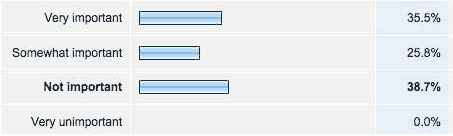
Our first question asked, "How important is it for your technology vendor to be a different company than the firm that provides translation services?" About 60 percent said technology independence was "somewhat important" or "very important."
Source: Common Sense Advisory, Inc.
Stated more bluntly, we were asking buyers what they felt about using technology tied to a specific language services provider (LSP), such as Lionbridge, Sajan, SDL, or Translations.com. Given the high proportion of "very important" responses coupled with zero buyers stating "very unimportant," the balance of opinion among buyers tilts radically toward concern on this topic, even though 39 percent said it was "not important."
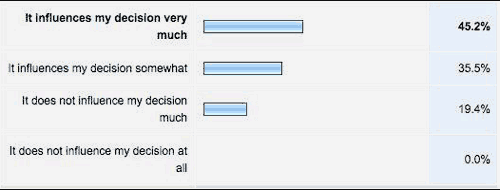
Next, we asked buyers if a guarantee of independence from the vendor would influence their purchasing decision. Over 80 percent indicated that it would.
Source: Common Sense Advisory, Inc.
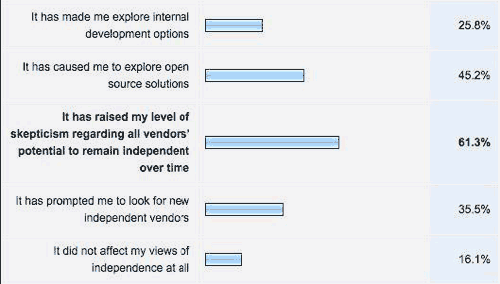
Expect non-service vendors to take advantage of this buying criterion, in both marketing platitudes and in the more hand-to-hand combat of direct selling. However, not all buyers will take such promises at face value. Last year, two notable independent software companies, Alchemy and Idiom, were swallowed by large LSPs (Translations.com and SDL, respectively). When we asked how recent mergers and acquisitions (M&A) had affected their views regarding vendor independence, 60 percent of buyers told us industry consolidation had raised their skepticism about any vendor's ability to remain independent over time.
Other reactions included 25 percent who said they were pushed to explore internal development options; 35 percent who set off to look for new independent vendors; and 45 percent for whom it triggered an exploration of open source solutions. Only 16 percent say the consolidation did not alter their views on vendor independence.
Source: Common Sense Advisory, Inc.
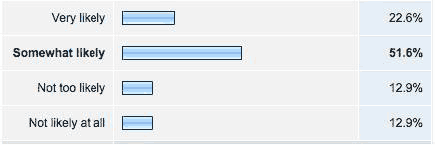
But apparently many companies did not need M&A activities to trigger their interest in open source. When we asked if it was likely their company would use open-source software for translation automation projects, nearly three out of four said they are "somewhat likely" or "very likely" to do so. This receptiveness could bode well for an open-source Global Sight — if Welocalize succeeds in mobilizing a community and eliciting a sense of ownership beyond itself.
Source: Common Sense Advisory, Inc.
Fewer companies are developing their own solutions for translation automation. Half said they were not, 30 percent said they were, and 20 percent claimed to be thinking about it.
Translation Buyers' Views on Technology Independence
Source: Common Sense Advisory, Inc.
So, our survey comes down to two conflicting datapoints:
* Our research on translation management systems (TMS) shows that most high-scoring systems are offered by language service providers, not by independent software vendors (ISVs). Suppliers such as Lionbridge, Sajan, SDL, and Translations.com are not only LSPs, but leading proponents of TMS in the openly available enterprise or captive "house" categories (house systems are available only through service agreements with those LSPs).
* However, buyers unequivocally tell us they worry about vendor independence and that it affects buying decisions.
This cognitive dissonance explains the difficult selling environment that LSPs find themselves in when pushing their proprietary technology approaches. And why unaffiliated software vendors have clay feet when it comes to the question of independence. Across, Beetext, and Kilgray have no financial ties to LSPs — yet. Maybe these new players will be the ones who finally turn the corner and prove that ISVs can survive in this service-oriented marketplace. But over the last decade, LSPs have harvested pretty much every leading software vendor in the space — more than 10 companies in all. Common Sense Advisory anticipates that acquisition by an LSP is still the most likely "exit strategy" for any globalization software vendor (GSV) operating today.
Published - April 2009
ClientSide News Magazine - www.clientsidenews.com
Corporate Blog of Elite - Professional Translation Services serving ASEAN & East Asia
Senior Analyst,
Common Sense Advisory
In late mid-2008, Common Sense Advisory asked buyers of translation services for their views on technology independence among their software and language vendors. Over half the 30-plus respondents hailed from North America; 35 percent were from Europe; the balance were scattered across that amorphous continent known as "Rest of World."
Our first question asked, "How important is it for your technology vendor to be a different company than the firm that provides translation services?" About 60 percent said technology independence was "somewhat important" or "very important."
Source: Common Sense Advisory, Inc.
Stated more bluntly, we were asking buyers what they felt about using technology tied to a specific language services provider (LSP), such as Lionbridge, Sajan, SDL, or Translations.com. Given the high proportion of "very important" responses coupled with zero buyers stating "very unimportant," the balance of opinion among buyers tilts radically toward concern on this topic, even though 39 percent said it was "not important."
Next, we asked buyers if a guarantee of independence from the vendor would influence their purchasing decision. Over 80 percent indicated that it would.
Source: Common Sense Advisory, Inc.
Expect non-service vendors to take advantage of this buying criterion, in both marketing platitudes and in the more hand-to-hand combat of direct selling. However, not all buyers will take such promises at face value. Last year, two notable independent software companies, Alchemy and Idiom, were swallowed by large LSPs (Translations.com and SDL, respectively). When we asked how recent mergers and acquisitions (M&A) had affected their views regarding vendor independence, 60 percent of buyers told us industry consolidation had raised their skepticism about any vendor's ability to remain independent over time.
Other reactions included 25 percent who said they were pushed to explore internal development options; 35 percent who set off to look for new independent vendors; and 45 percent for whom it triggered an exploration of open source solutions. Only 16 percent say the consolidation did not alter their views on vendor independence.
Source: Common Sense Advisory, Inc.
But apparently many companies did not need M&A activities to trigger their interest in open source. When we asked if it was likely their company would use open-source software for translation automation projects, nearly three out of four said they are "somewhat likely" or "very likely" to do so. This receptiveness could bode well for an open-source Global Sight — if Welocalize succeeds in mobilizing a community and eliciting a sense of ownership beyond itself.
Source: Common Sense Advisory, Inc.
Fewer companies are developing their own solutions for translation automation. Half said they were not, 30 percent said they were, and 20 percent claimed to be thinking about it.
Translation Buyers' Views on Technology Independence
Source: Common Sense Advisory, Inc.
So, our survey comes down to two conflicting datapoints:
* Our research on translation management systems (TMS) shows that most high-scoring systems are offered by language service providers, not by independent software vendors (ISVs). Suppliers such as Lionbridge, Sajan, SDL, and Translations.com are not only LSPs, but leading proponents of TMS in the openly available enterprise or captive "house" categories (house systems are available only through service agreements with those LSPs).
* However, buyers unequivocally tell us they worry about vendor independence and that it affects buying decisions.
This cognitive dissonance explains the difficult selling environment that LSPs find themselves in when pushing their proprietary technology approaches. And why unaffiliated software vendors have clay feet when it comes to the question of independence. Across, Beetext, and Kilgray have no financial ties to LSPs — yet. Maybe these new players will be the ones who finally turn the corner and prove that ISVs can survive in this service-oriented marketplace. But over the last decade, LSPs have harvested pretty much every leading software vendor in the space — more than 10 companies in all. Common Sense Advisory anticipates that acquisition by an LSP is still the most likely "exit strategy" for any globalization software vendor (GSV) operating today.
Published - April 2009
ClientSide News Magazine - www.clientsidenews.com
Corporate Blog of Elite - Professional Translation Services serving ASEAN & East Asia
Subscribe to:
Posts (Atom)


 Posts


